Hybrid Security Explained: How Physical Guards and AI-Enabled Electronic Security Work Together
Integrated security solutions put trained guards and AI-enabled electronic systems under one plan. See how they work on a site and what to ask a provider.
In integrated security solutions, the security measures are combined so that the human guards and the AI-assisted electronic systems are included in one plan, the cameras carrying out the surveillance and the people making the decisions.
When a payment is required, it is the more detailed explanation that matters most because many providers offer guards and cameras as separate contracts and refer to the combined setup as ‘hybrid’. The article examines how the two systems function together on a site, what the AI does and what it does not do, and the questions you should ask before agreeing to anything.
Why neither guards nor cameras are enough alone
Everyone who has carried out a night shift at a gate will recognise this situation. During the first hour you are able to pick up all the details, but by the fourth hour your concentration begins to drop and one section of a big site disappears from view when you are on duty. Cameras do help since they never get tired and they monitor the areas that are hard to see.
Nevertheless, they can’t go over and ask a stranger who he is and then judge whether his answer sounds reasonable. A camera which has recorded a break-in has finished its task, but no one is made any safer as a result. When the two methods are used together, each one makes up for the other’s weaknesses. This is the reason why integrated security solutions have been created: they involve a single operation in which both people and technology carry out the same plan.
How integrated security solutions work on a normal night
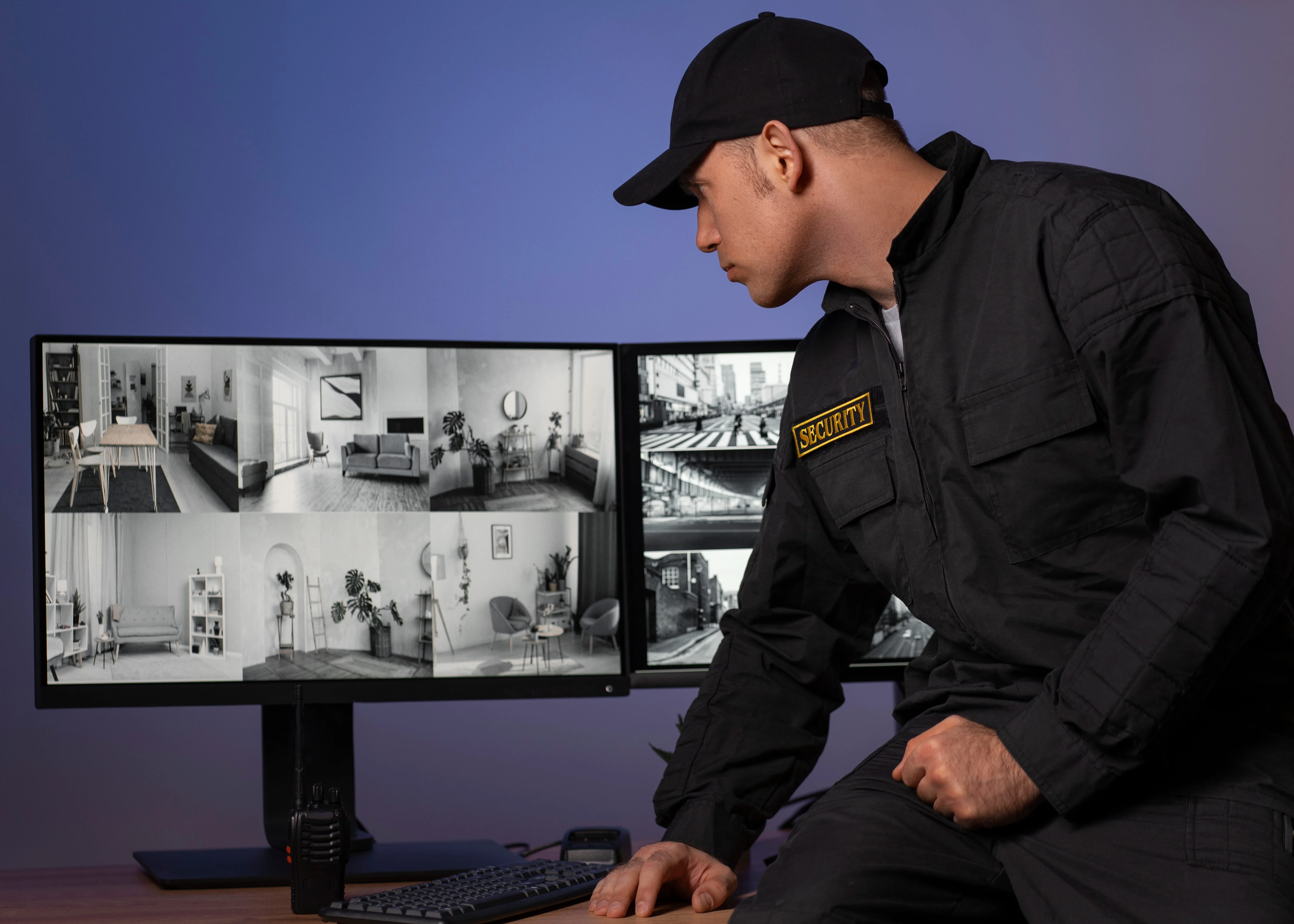
Visit the corporate campus after business hours. The system is designed to detect movement in a restricted area, and at 2 a.m. it detects a person close to the rear boundary wall. Rather than giving an immediate alarm to a guard, it sends the alarm to a control-room operator. The operator checks the footage and sees that someone is climbing the wall, after which he or she sends a clear description to the guard nearest to that area about what to expect. The guard arrives within a few minutes and the supervisor then records both the findings and the length of time the response took.
In the case of a stray dog the operator would have closed the alert and there would have been no point in sending anyone out. That is the reason that analytics are so important: they reduce the number of false alarms reaching the people who have to go out into the dark. The correct procedure is always to detect, verify, respond and record.
What the AI actually does
The analytics enable the control room to focus on the right screen at the right time; in reality this involves giving warnings when people or vehicles are in restricted areas, spotting the fact that a bag has been left behind, counting the number of people at an entrance or reading the number plates at a gate. The system doesn’t make the final decision or take over any of the guards’ responsibilities since each alert must be checked by a human member before any guard is dispatched.
It is just as important to clarify what is covered; this is physical security relating to people, property, and sites, and it does not extend to the protection of data networks.
Where integrated security solutions earn their cost
Security systems that are integrated function most effectively in places which are too large, too crowded or too open for security guards to cope with alone. Corporate campuses and IT parks have very large perimeters and a large number of entry points. In the case of high-value houses it is essential to have gate inspections and visitor control which do not rely on a single person being on duty.
Construction and industrial sites are left unattended during the night, that is precisely when security is needed most. Large events are constantly changing from minute to minute, and it is thanks to the cameras that staff are able to notice a crowd forming before it becomes a problem.
In each such case, the right combination is reached by carrying out an assessment at the site regarding the layout, the entry points, the working hours and the level of risk, not by depending on a fixed package.
How this differs from the CCTV vs AI question
We have already examined the comparison between CCTV surveillance systems and those based on AI, an article in which the suitability of various camera technologies for a business is discussed. The present article, on the other hand, looks at the next stage: after the cameras have been selected, what is the relationship between them and the guards? A high-quality camera will still be part of a faulty system if no one responds to its alarms.
What to ask a provider of integrated security solutions
Although many companies are capable of providing guards and installing cameras, only a few can offer a single chain of command for both of these services. It is important to find out who is in charge when an alert takes place and how quickly they react to it, as well as to enquire about the way in which the guards are informed, dispatched and supervised, and whether the same person is responsible for both the guards and the electronic systems.
You should also request to see how incidents are recorded and investigated. Lastly, make sure that the basic requirements are met in that private security companies in India must hold a valid PSARA licence; moreover, a reliable supplier will carry out a site inspection before giving you any quotation.
If you haven’t already carried out the shortlisting process, then our article on how to hire the best security guard agency in Mumbai looks at the manpower issue; the one which compares in-house security with outsourced security explains the importance of teams led by veterans, while our security guard pricing guide provides an idea of the costs.
The Bottom Line
The judgement is made by the guards and the coverage is given by the cameras; integrated security solutions can only function if both are based on the same plan, are supervised by the same person, and maintain an identical record of the events. The technology is meant to help the people on the ground, not to replace them.
If you want to find out more about integrated security solutions which have been designed for your site, you can contact the Victor Squad team via our contact page or have a look at our services page first.
Frequently Asked Questions
What is meant by integrated security solutions?
Integrated security solutions bring trained guards and electronic systems such as CCTV, analytics, alarms, and access control together as one interconnected operation, rather than as individual contracts that never communicate with each other.
Can AI assume the role of security guards?
Exactly the opposite is the case: the system generates the alerts and then a person has to examine each one and take the proper action; it is the guards who respond.
Can it be said that integrated security solutions are appropriate only for large sites?
No. A valuable house with a gate, several cameras, and a trained guard can make use of the same principle; the size of the setup will depend on the property but the fundamental idea remains unchanged.
How does an integrated security system reduce the number of false alarms?
The operator will check each alert before the guards are sent, so that the guards only respond to events which have been confirmed and not to each alert that has been automatically flagged.The operator will check each alert before the guards are sent, so that the guards only respond to events which have been confirmed and not to each alert that has been automatically flagged.
Is the expense involved in using integrated security solutions more than the cost of simply hiring guards?
How much this is so will depend on the size of the job and the level of risk involved; although there is an initial cost connected with the electronics, verification still reduces the number of unnecessary call-outs.